
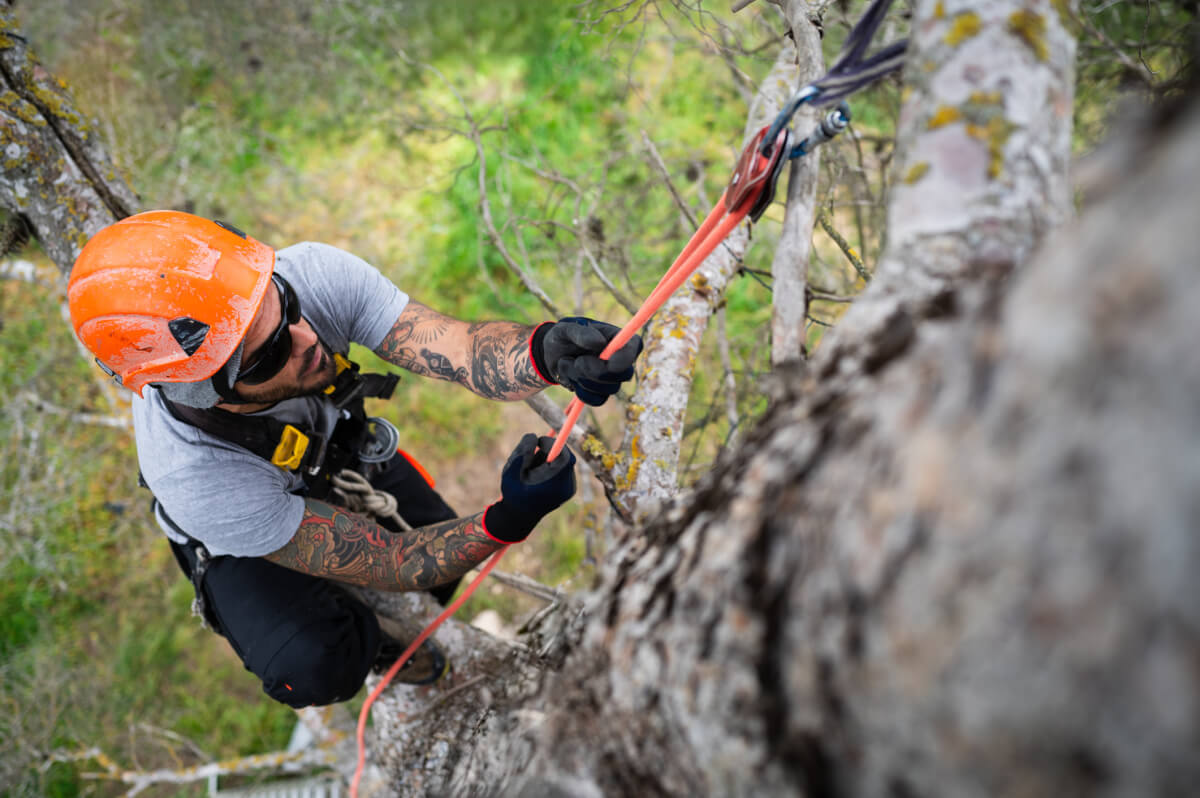
There’s a tulip poplar leaning toward your roofline and you’ve been watching it for two winters. Or a big oak dropped a limb the size of a fence post during the last round of storms, and now you’re wondering what else is hanging up there where you can’t see it. Either way, you’re about to let someone run a chainsaw forty feet above your house.
Here’s the part most homeowners don’t find out until they’re already in it: North Carolina doesn’t license arborists. There’s no state exam, no state board, no credential anybody has to earn before printing “tree service” on a magnetic door sign. The bar to entry is a truck, a saw, and a phone number.
That’s exactly why the ISA Certified Arborist credential carries so much weight around here. It’s one of the only reliable signals you have — and it’s easy to verify in about two minutes if you know where to look.
What ISA Certification Actually Means
The International Society of Arboriculture is the professional body for tree care worldwide. To sit for the Certified Arborist exam, a candidate needs at least three years of full-time practical experience in arboriculture, or a related degree plus a shorter work history. The exam itself covers tree biology, soil science, pruning practices, diagnosis, cabling and bracing, climbing and rigging safety, and tree risk. It isn’t a weekend course.
Certification also has to be maintained. Certified arborists earn continuing education credits on a three-year cycle, which means the credential reflects someone who’s stayed current rather than someone who passed a test in 2009 and never opened a manual again.
The practical difference shows up in how the work gets done. Certified arborists follow ANSI A300, the national standard for tree care operations, and ANSI Z133 for safety. A300 is the reason a certified arborist won’t top your trees — cutting a mature canopy back to stubs is not an accepted practice, it permanently weakens the tree, and it creates the weak regrowth that fails in the next windstorm. If someone offers to “top” your oak to make it safer, that single sentence tells you everything about their training.
Asheville’s Terrain Makes This a Different Job
Tree work in Buncombe County isn’t the same job it is in Raleigh. We’ve got mature hardwood canopy growing on grades that would qualify as cliffs in most of the state, thin soil over rock in a lot of places, and enough annual rainfall to keep root zones saturated for weeks at a stretch.
Saturated soil on a steep lot is how healthy-looking trees end up on their sides. The tree didn’t snap — the root plate let go. A trained eye can spot the signs before that happens: soil heaving on the uphill side, a lean that’s changed, fungal conks at the base, a canopy that’s thinning from the top down. Those are diagnostic calls, not chainsaw calls.
Then there’s the removal itself. Dropping a 90-foot white pine on a flat quarter-acre in the Piedmont is one problem. Taking that same tree down on a Kenilworth hillside, over a driveway, between a power line and a neighbor’s roof, with no room for a bucket truck, is a rigging problem — and rigging is where undertrained crews get people hurt and put limbs through roofs.
If you’re in Montford, Beaverdam, Town Mountain, Chunn’s Cove, or anywhere else with real slope and real canopy, ask specifically how the crew plans to get the tree down. The answer should be detailed.
Credentials Worth Knowing Beyond the Basic Certification
The base certification is the floor, not the ceiling. Depending on your situation, a few additional credentials are worth asking about:
- TRAQ (Tree Risk Assessment Qualified) — specialized training in evaluating and documenting the likelihood of tree failure. If your question is “is this tree actually dangerous or am I overreacting,” this is the person to ask.
- Board Certified Master Arborist — ISA’s highest credential, requiring years of certified experience plus a much harder exam. Relatively few hold it.
- ASCA Registered Consulting Arborist — built for written reports, tree appraisals, and expert testimony. Relevant if you’re dealing with a property line dispute, an insurance claim, or a builder who damaged trees during construction.
- TCIA Accreditation — a company-level credential from the Tree Care Industry Association covering business practices, safety programs, and employee training, not just one person’s exam score.
- NC pesticide applicator license — required through the NC Department of Agriculture for anyone applying treatments for pests or disease. If a company wants to treat your trees, they need this.
One useful distinction: an arborist and a tree removal crew are not automatically the same thing. Plenty of good, safe removal outfits do excellent work without a certified arborist on staff. But if you want a diagnosis, a risk assessment, a pruning plan, or a written opinion, you want the credential.
Insurance Is the Other Half of the Equation
Certification says the person knows trees. Insurance says you’re not paying for it when something goes wrong — and in tree work, things go wrong at height, over your house.
Ask for two things: general liability and workers’ compensation. General liability covers damage to your property. Workers’ comp covers injuries to the crew, which matters enormously to you, because an uninsured worker hurt on your property can become your financial problem. North Carolina requires workers’ comp for businesses with three or more employees.
Don’t accept a photo of a certificate. Ask for a certificate of insurance sent directly from the agency or carrier, with your name and address listed. It takes a legitimate company about ten minutes to arrange, and it costs you nothing. A company that stalls on this request is telling you something.
We asked Sascha Hopps, an ISA Certified Arborist who runs Gravity Works Tree Service in Asheville, what homeowners most often get wrong. He put it more bluntly than we would:
“There are tons of uninsured hacks. If you want care and quality work, honesty and accountability, and someone with an actual insurance policy, call an ISA arborist.”
— Sascha Hopps, ISA Certified Arborist #SO-11137A, Gravity Works Tree Service
Know Your Permit Situation Before Anyone Starts Cutting
Most single-family tree removal inside Asheville isn’t regulated — but there are real exceptions, and they catch people off guard.
Properties in the city’s steep slope zones have restrictions on tree removal and vegetation, with tighter rules at higher elevations. Local historic districts, including Montford, have their own review process for tree removal. And any tree in the public right-of-way — the strip between the sidewalk and the street, for example — can’t be pruned or removed without a permit from Public Works, regardless of who’s paying for it.
Rules and elevation thresholds get revised, so confirm your specific address with the City of Asheville’s Development Services Department before work begins. Outside city limits, check with Buncombe County. A good contractor will raise the permit question before you do; if they wave it off, that’s a flag. Our Buncombe County building permit guide covers the wider picture if you’ve got other work planned.
Red Flags
- They knocked on your door after a storm, unsolicited, and want to start today.
- They ask for a large cash deposit up front, or the full amount before work.
- They offer to “top” your trees.
- There’s no written contract listing the specific trees, the scope, the cleanup, and stump handling.
- They can’t produce a certificate of insurance from the carrier.
- They plan to climb your tree in spikes for a pruning job — spikes wound the trunk and belong on removals only.
- The quote is dramatically lower than everyone else’s, with no explanation of why.
Storm seasons in Western North Carolina reliably bring out-of-state crews into the area, and some of them are excellent. But the same conditions bring operators who work for cash, carry no coverage, and are three counties away by the time you notice the damage to your lawn or your roof.
Why Your Quotes Won’t Match Each Other
Homeowners often collect three bids expecting three versions of the same number, then assume the low one is the deal and the high one is padding. That’s not how this trade works, and the reason goes back to the same gap in regulation that makes certification matter in the first place.
“There is no one-size-fits-all to tree care. Every job is different, every tree is a different problem to solve. There is no standardized pricing, my work costs what it costs. Because of the lack of regulation, pricing is relative to the cost of doing business.”
— Sascha Hopps, ISA Certified Arborist #SO-11137A, Gravity Works Tree Service
Read that last line carefully, because it’s the whole thing in one sentence. A company carrying workers’ comp, maintaining rigging gear, and paying a certified arborist has a higher cost of doing business than a two-person crew working for cash out of a pickup. The bids reflect that. When one number comes in far under the others, the useful question isn’t “why are the rest so expensive” — it’s “what is this crew not paying for.”
So compare scopes, not just totals. Which trees, what happens to the debris, is the stump included, who’s liable if something lands wrong.
How to Verify a Credential in Two Minutes
Ask for the arborist’s certification number, then check it yourself. The ISA maintains a public credential verification tool and a searchable arborist directory at treesaregood.org, where you can confirm the name, the certification number, and whether it’s currently active. There’s no reason to take anyone’s word for it.
It’s also fair to ask which specific person on the crew holds the certification and whether that person will actually be on your property during the work. “We have a certified arborist on staff” and “a certified arborist will assess your trees and supervise the job” are different statements.
The same principle applies to every trade you hire — our guide on how to check if a contractor is licensed in North Carolina walks through the state boards that do issue licenses.
What to Ask Before You Sign
- Who on your team is ISA certified, and what’s their certification number?
- Will that person be on site for the assessment, the work, or both?
- Can your agent email me a certificate of insurance showing general liability and workers’ comp?
- What’s your plan for getting this tree down given the slope and what’s underneath it?
- Does anything about my property require a permit before you start?
- What happens to the debris, and is stump grinding included or extra?
- If this tree can be saved instead of removed, what would that look like and what would it cost?
That last question is worth asking sincerely. A certified arborist’s job is tree health, not tree volume, and a good one will sometimes talk you out of a removal you came in convinced you needed. Mature canopy is genuinely hard to replace in this landscape — it’s holding soil on your slope, cutting your summer cooling load, and doing more for your property value than most improvements you could buy.
Your Next Step
Before you call anyone, walk your property and take photos of what’s worrying you — the lean, the cracked limb, the mushrooms at the base, the bare spot in the canopy. Note which trees are within striking distance of the house, the driveway, or the power line. That gives you something concrete to point at, and it keeps the conversation focused on the trees that actually matter.
Then get at least two written assessments from certified arborists, verify both certification numbers before anyone climbs anything, and browse the tree service listings in the AshevillePros directory to find local pros who work in this terrain every week.
Frequently asked questions
Does North Carolina license arborists? No. There is no state license, no state exam, and no state board for arborists in North Carolina. Anyone can advertise tree work without earning a credential first. That’s why the ISA Certified Arborist designation matters here — it’s a voluntary professional credential, and it’s one of the only reliable signals a homeowner has.
How do I check if an arborist is ISA certified? Ask for their certification number, then verify it yourself at treesaregood.org, where the International Society of Arboriculture maintains a public credential search. You can confirm the name, the number, and whether the certification is currently active. It takes about two minutes.
Do I need a permit to remove a tree in Asheville? Most single-family tree removal inside Asheville isn’t regulated, but there are exceptions. Properties in the city’s steep slope zones have restrictions on tree and vegetation removal, local historic districts like Montford have their own review process, and any tree in the public right-of-way requires a permit from Public Works. Confirm your specific address with the City of Asheville’s Development Services Department, or with Buncombe County if you’re outside city limits.
Why are tree removal quotes so different from company to company? Because there’s no standardized pricing in a trade the state doesn’t regulate. Every tree is a different rigging problem, and a company carrying workers’ compensation, maintaining gear, and employing a certified arborist has a higher cost of doing business than a crew working for cash. Compare the scope of each bid — which trees, debris handling, stump grinding, liability — rather than comparing totals.
Is it OK to top a tree to make it safer? No. Topping — cutting a mature canopy back to stubs — is not an accepted practice under ANSI A300, the national standard for tree care. It permanently weakens the tree and produces weak regrowth that tends to fail in the next windstorm. A company that offers to top your trees is telling you about their training.
What insurance should a tree service carry in North Carolina? General liability, which covers damage to your property, and workers’ compensation, which covers injuries to the crew. North Carolina requires workers’ comp for businesses with three or more employees. Ask for a certificate of insurance sent directly from the agency or carrier with your name and address on it, rather than accepting a photo of a certificate.